This documentation serves to help both stakeholders and iQ users to understand:
1. The metadata elements that make up the iQ Metadata Fitness object, and
2. Why these elements were chosen in regards to the importance they play in a title's metadata health.
Summary Data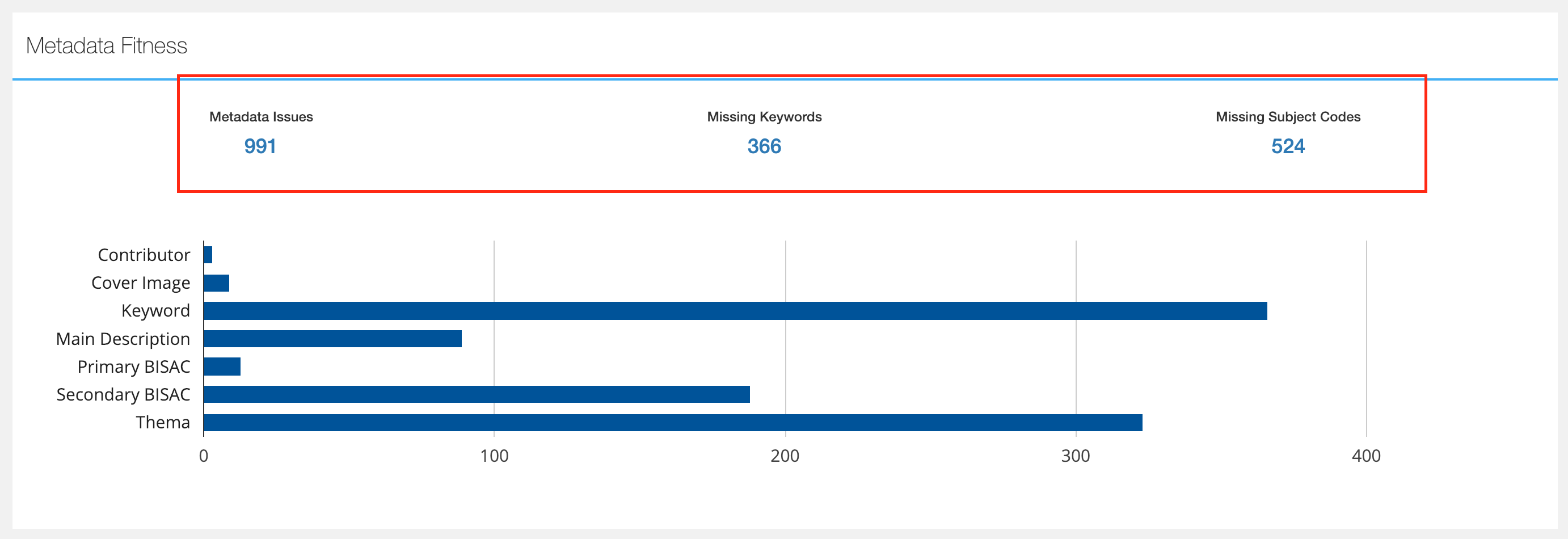
Metadata Issues
What: The total number of metadata issues with the entire catalogue. This is a sum of all the metadata issues listed in the entire Metadata Fitness object.
Why: This helps users to get an immediate idea of how many metadata problems exist within their catalogue. As they improve their metadata, this number will gradually decrease, giving them a progressional satisfaction in updated their data.
Missing Keywords
What: The number of titles in the publisher's catalogue that is missing keywords entirely.
Why: Keywords are one of the most important pieces of metadata due to their impact on discoverability across the modern digital marketplace. This will help publishers to know how much of their catalogue is missing keywords and, comparatively, how many of their total metadata issues are keyword-related.
Missing Subject Codes
What: A count of titles that are missing either Primary BISAC, Secondary BISAC, or Thema codes. If any of these are missing on a title, the title will be counted here.
Why: Subject metadata is used by retailers to categorize your title. The more present and appropriate your subject codes, the more likely your title will be found by those looking for it. BISAC codes have long been a book industry standard, and Thema is on the rise internationally. All three subject codes are important to include on every single title.
Drilldowns
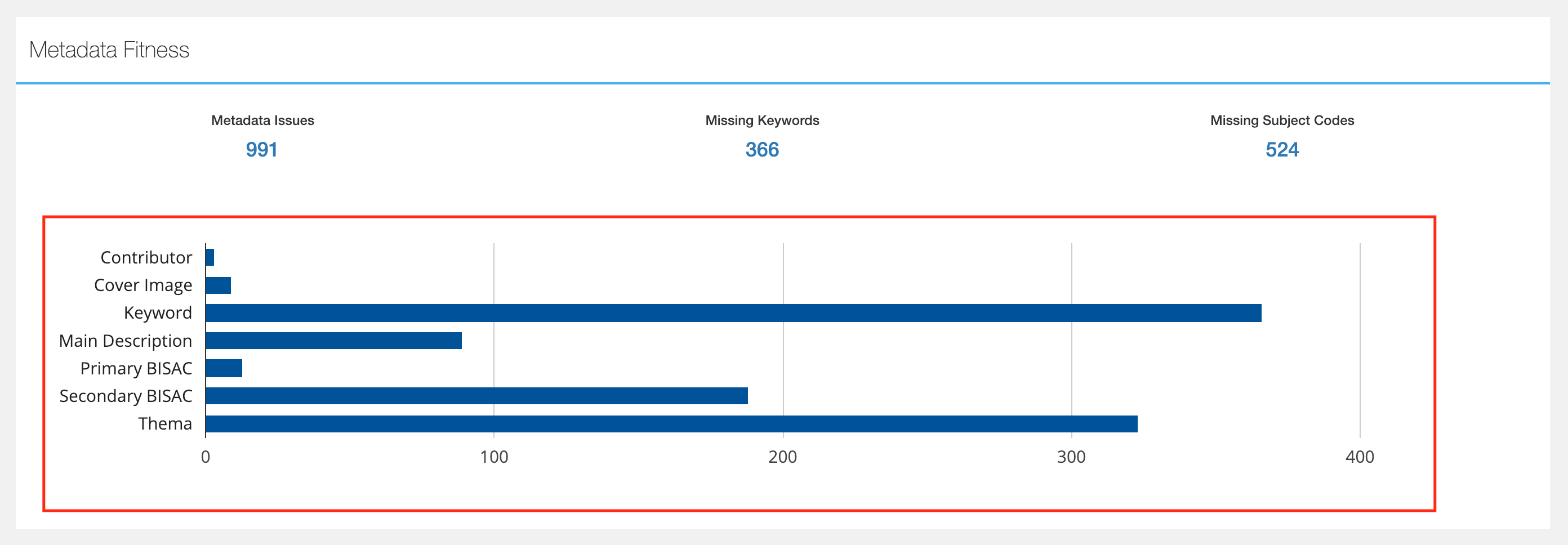
Contributor
What: The contributor is the generally your author, but additional contributors can be participants like illustrators or others. This indicates how many titles have no contributors whatsoever.
Why: This information is vital for publishing. Retailers may reject a book that does not have a contributor listed.
Keyword
What: This is the count of titles that have no keywords at all.
Why: Keywords are the driving force of discoverability for titles in the digital marketplace. Retailers will use keywords to drive consumers to titles, encouraging purchases by leading relevant buyers to books they will be interested in.

Main Description
What: Sometimes referred to as "narrative content" or the "marketing copy", this is the primary description that consumers see when the book is listed. Generally this will include a prominent headline and HTML formatting to catch reader's attention.
Why: Missing the main description means that consumers who stumble across the book will have zero idea about its contents. This is another critical piece of metadata that needs to exist and needs to be well maintained/written properly.
Primary BISAC
What: The primary BISAC (sometimes referred to as BISAC 1) should be the BISAC subject code that best represents the book.
Why: The presence of a primary BISAC generally allows retailers to categorize a book into the proper broad category. This helps relevant consumers find the book more quickly. The more specific your primary BISAC is, the more likely those who are looking for your book will find it; for this reason, avoid any sort of general primary BISACs.
Secondary BISAC
What: These the second and third BISAC subjects (sometimes called BISAC 2 and BISAC 3) that provide additional context to the primary BISAC.
Why: While retailers are more likely to lean on the primary BISAC, secondary BISACs are helpful in clarifying your books topics even more. It is highly recommended that every book in a catalogue have 3 total BISACs (1 primary BISAC, and 2 secondary BISACs) to ensure proper categorization across the wide variety of retailers in the modern digital marketplace.
Thema
What: Thema is a subject code (similar to BISAC codes) that are used primarily internationally.
Why: There is a big push for Thema codes to become the "international standard" for book subject categorization. Because of this, many retailers are starting to accept them and utilize them to categorize books. It is in a publisher's best interest to include Thema codes (in addition to BISAC codes) on every title in their catalogue to ensure that they are prepared for potential wide-spread usage of the Thema code, even if they are not currently distributing internationally.